Alpha Picks Review (2026): Is It Worth $499 a Year?
Alpha Picks costs $499 a year, $449 the first year through our link. How Seeking Alpha's quant team picks two stocks a month, and who should pay for it.
 By Aslam Ghouse, CFA · Ex-Goldman Sachs systematic trader · Updated 6 Oct 2026
- Our rating
- 4.5 / 5
- Trial
- None. Charged up front; the offer page shows no free trial
- Refund
- None. Seeking Alpha's policy page says fees are non-refundable; cancel any time and access runs to the end of the year paid for
- Best for
- Buy-and-hold investors with $50,000 or more who want two model-chosen picks a month with sell alerts, and will follow them
We earn a commission if you subscribe through this link, at no extra cost to you. It has no bearing on what the model ranks or what we cover.
Some links in this article are affiliate links. How we get paid · How we review.
Alpha Picks is Seeking Alpha's stock-picking service. Its quant team, the people who build Seeking Alpha's ratings, chooses two stocks a month from the stocks its Quant Rating grades Strong Buy. You get an email when a rating falls to Sell. It costs $499 a year, or $449 for the first year through our link, and has run since July 2022. Alpha Picks is one of three Seeking Alpha tiers; the Seeking Alpha review compares all three.
My take: the most disciplined pick service sold to individuals, because the buy rules and the sell rules are published and the model follows them. Worth $449 for a buy-and-hold investor with $50,000 or more who will follow the alerts. Too dear for a small portfolio, and the wrong product for anyone who wants to do their own research.
On a rules-run trading desk the sell was decided before the buy, which is why the sell rules below matter to me more than the picks. What follows is how Alpha Picks selects, when it sells and what it costs. Then I compare it with Seeking Alpha Premium, Motley Fool Stock Advisor and our own membership. Prices and terms were checked on Seeking Alpha's offer pages and help centre on 16 September 2026.
What is Alpha Picks? Understanding the service
Alpha Picks is Seeking Alpha's model portfolio: a list of stocks it buys and sells on paper for subscribers to copy. It launched in July 2022 and is run by Seeking Alpha's quantitative team. Seeking Alpha calls it a low-frequency, buy-and-hold strategy. It adds two new positions a month, aims to hold each for at least a year, and makes two to three trades a month in total.
What subscribers get
- Two picks a month, one on the first trading day and one on the 15th or the next trading day
- The full pick history since July 2022, and the current portfolio with its weights
- Sell and trim alerts by email, on published rules
- The analysis behind each pick, plus overviews of the wider economy and earnings updates from the quant team
- Members-only webinars with the quant team
- An allocation tool that turns the model weights into share counts for your own portfolio size
Alpha Picks does not include Seeking Alpha Premium. If you also want the Quant Ratings, screener and articles, you buy the two together as a bundle, covered under pricing below.
How Alpha Picks selects
The Alpha Picks methodology is short enough to state in full. A stock qualifies when, on the pick date, it:
- Has held a Strong Buy Quant Rating for at least 75 consecutive days
- Is a US common stock, so no ADRs and no REITs
- Has a three-month average market cap above $500 million
- Trades above $10
- Has not been picked in the past year
The Quant Rating behind step one grades each stock against its sector on five measures. They are valuation, growth, profitability, momentum and earnings revisions, meaning changes to analysts' profit forecasts. Seeking Alpha calls the combination "quantamental". In practice it is a rank built from those measures of each company's numbers. The 75-day rule filters out stocks that flicker into Strong Buy for a week.
When it sells
The sell rules are what separate Alpha Picks from most pick newsletters, which tell you what to buy and then go quiet. The model sells the whole position when:
- The rating falls to Sell or Strong Sell
- The rating sits at Hold for 180 consecutive days
- The company becomes an acquisition target or announces a merger of equals
A position that grows to 15% of the portfolio is trimmed to 10%, and the proceeds are spread equally across the other holdings. A stock that has doubled is a "winner". If a winner drifts to Hold for 180 days, the model sells the original stake and lets the gain run. It repeats that every further 180 days at Hold. Dividends are reinvested in the stock that paid them.
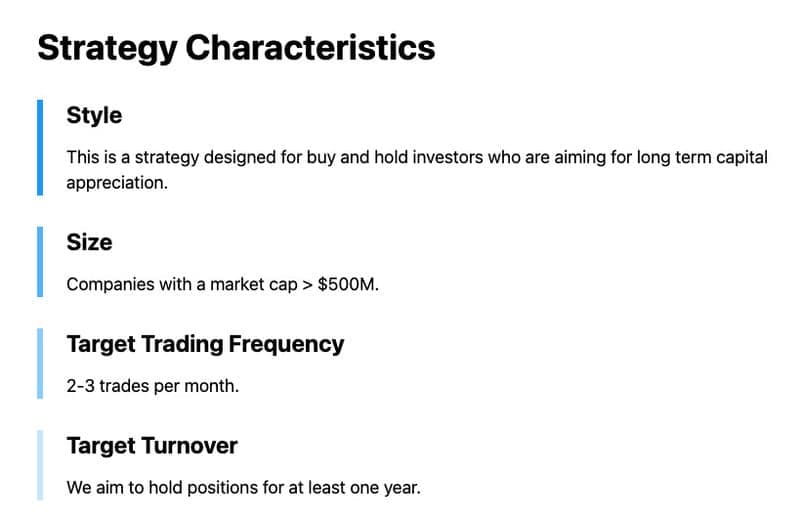
Alpha Picks strategy characteristics. Source: Seeking Alpha.
The team behind Alpha Picks
Alpha Picks is run by Steven Cress, Seeking Alpha's head of quantitative strategy, with Joel Hancock, its VP of product, as co-founder.
Steven Cress
Cress founded CressCap Investment Research, which Seeking Alpha bought in December 2018, and the Quant Rating system grew out of it. Before that he founded and ran Cress Capital Management, a hedge fund that picked stocks by the numbers. He also ran a desk at Morgan Stanley that traded the bank's own money, and held senior roles at Northern Trust and Sunrise Brokers.
Joel Hancock
Hancock spent fourteen years building financial products at Goldman Sachs, Morgan Stanley, E*TRADE and TradeIt before co-founding Alpha Picks. The product side shows. The portfolio page, the alerts and the allocation tool are simpler to use than most of Seeking Alpha.
What Seeking Alpha publishes about performance
Seeking Alpha publishes a since-launch return for the Alpha Picks model portfolio against the S&P 500 on the Alpha Picks page. It is calculated as time-weighted returns on a hypothetical portfolio from July 1, 2022. That means the return the rules would have earned on paper, with the effect of cash going in or out removed. It uses opening prices until July 30, 2024, and since then the day's average traded price, weighted by volume. Seeking Alpha's own page states that Alpha Picks is a model portfolio, not real money, and not an audited record that meets the GIPS reporting standard.
Three things to hold in mind when you read that page. The record is a little over four years old. That covers one bear market (2022) and one long recovery, so it has not been tested across a full cycle. The model lets winners run, so a few large gains carry a lot of the total, and the headline number says little about the typical pick. And any model portfolio's return is what the rules would have earned; yours depends on when you joined and what you bought.
How much does Alpha Picks cost?
Prices come from Seeking Alpha's Alpha Picks and bundle offer pages, checked 16 September 2026; the bundle price was rechecked on 30 September 2026. The Quant Growth & Income bundle was checked on 6 October 2026.
| List price | First year through our link | Trial | Renews at | ||
|---|---|---|---|---|---|
| Alpha Picks | $499 a year | $449 ($50 off) | None; charged up front | $499 a year | Save $50 |
| Alpha Picks + Premium | $798 a year | $629 ($169 off) | None | $499 and $299, each at list | Save $169 |
| Alpha Picks + Quant Growth & Income | $998 a year | $719 ($279 off) | None | Not stated on the offer page; $998 at list | Save $279 |
No free trial and no refund. The offer page charges the full year up front. Seeking Alpha's cancellation policy says subscription fees are non-refundable. The 30-day money-back guarantee you may have read about applies only to Investing Group annual plans. You can cancel at any time from the subscription settings page and keep access to the end of the year. The subscription renews at $499 unless you do. Put the renewal date in your calendar the day you subscribe.
What the fee costs you, by portfolio size
- $10,000 portfolio: $449 is 4.5% of your money a year, before any stock does anything. Too expensive.
- $50,000 portfolio: 0.9% a year, about what an active fund charges. Reasonable if you will follow the picks.
- $100,000 and above: under 0.5% a year. The fee stops being the main risk to the return.
The fee is fixed, so the service gets cheaper as the portfolio grows. Below about $30,000 the sums work against you. Seeking Alpha Premium at $269, with the free trial, is the better use of the money there.
$50 off the list price of $499, applied on Seeking Alpha's offer page. Renews at $499.
If you also want the Quant Ratings, screener and articles, the Premium and Alpha Picks bundle is $629 for the first year, $169 less than buying both.
Alpha Picks vs Seeking Alpha Premium
The two products come from the same company and do different jobs.
| Alpha Picks | Seeking Alpha Premium | |
|---|---|---|
| What it is | A model portfolio with two picks a month | A research platform: ratings, screener, articles, portfolio tools |
| Who decides | Seeking Alpha's quant team, on published rules | You |
| Sell discipline | Email alerts on the rules above | None; the ratings change and you watch them |
| Research tools | The analysis behind each pick | The full site |
| Price | $499 a year, $449 the first year | $299 a year, $269 the first year, 7-day free trial |
| Best for | Investors who want a list to follow | Investors who want to build their own view |
If you enjoy the research and want the tools, Seeking Alpha Premium is the better buy and costs less. If you want the decisions made on rules and delivered, Alpha Picks is the product. Seeking Alpha's third tier, Pro at $2,400 a year, adds a 30-stock model portfolio that resets its holdings every week, with no market-cap floor. Pro is for active investors with large portfolios, and that review compares it with Alpha Picks.
Alpha Picks vs Quant Growth & Income
Quant Growth & Income is Seeking Alpha's second model portfolio, launched on 3 June 2026. Both are run by the quant team and both start from the Quant Rating. They aim at different things.
| Alpha Picks | Quant Growth & Income | |
|---|---|---|
| Aim | Long-term growth, against the S&P 500 | Growth plus dividend income, against the Vanguard High Dividend Yield ETF (VYM) |
| Way in | 75 days at Strong Buy, cap above $500m, price above $10 | Pays a dividend, meets set dividend grades, Buy or Strong Buy for a set run of days, cap of $400m or more |
| What it holds | US common stocks only; the portfolio grows by two picks a month | Up to 30 stocks, including ADRs, REITs and small companies |
| Trades | Two picks a month; sells on the rules above | Rebalanced every second Wednesday, about two changes each time |
| Record since | July 2022 | June 2026 |
| Price | $499 a year, $449 the first year | $499 a year, $449 the first year |
Seeking Alpha's own comparison sets them against each other on volatility, meaning how far prices swing. It calls Alpha Picks the higher-volatility choice and Quant Growth & Income the lower one. Choose by what you need the money to do. If you want income from your stocks, Quant Growth & Income is built for that and Alpha Picks is not. If you want growth and can sit through larger drops, Alpha Picks. Quant Growth & Income's record is four months old, so the choice rests on the rules, not the returns.
The two together are $719 for the first year, against $998 bought separately. The bundle does not include Premium. The Seeking Alpha review covers Quant Growth & Income's rules and terms in more detail.
Alpha Picks vs Motley Fool Stock Advisor
This is the closest rival, and the comparison most readers are really making. Both send two picks a month for buy-and-hold investors. The differences are who chooses and what it costs.
| Alpha Picks | Motley Fool Stock Advisor | |
|---|---|---|
| Who picks | A quant model, from Strong Buy-rated stocks | Motley Fool's analysts |
| Selection rules | Published: 75 days at Strong Buy, cap above $500m, price above $10 | An analyst's written case for each pick |
| When to sell | Published rules, with email alerts | Rare; the guidance is to hold five years or more |
| Price | $499 a year, $449 the first year | $199 a year, $99 the first year |
| Since | July 2022 | 2002 |
Choose Stock Advisor if you want a long public record, a written argument for each pick and the lower price. Choose Alpha Picks if you want the selection and the exit made by rules rather than by an analyst's conviction. Our Motley Fool Stock Advisor review covers what the record looks like once the three largest winners are removed.
Alpha Picks vs Ticker Nerd
I run Ticker Nerd, so I owe you a plain comparison. Both are rules-based; the difference is what you receive.
| Alpha Picks | Ticker Nerd | |
|---|---|---|
| What you get | Two picks a month, added to a growing model portfolio | The Ticker Nerd 20: a fixed twenty-stock growth portfolio |
| Who decides | Seeking Alpha's quant team, on published rules | Published rules over a ranked ~1,500-stock universe |
| Cadence | Two picks a month; sells on rating changes | Reviewed every four weeks; every trade published |
| Record | The vendor's model-portfolio return, on its page | On the join page: every trade, losers included |
| Price | $499 a year, $449 the first year | $39 a month or $199 a year |
Alpha Picks suits an investor who wants to add to a portfolio twice a month and manage the exits from alerts. Ticker Nerd suits one who wants the whole portfolio decided and explained, and would rather check it every four weeks than watch a rating. A Premium subscriber can run the twenty names through the factor grades; plenty of members do.
Is Alpha Picks worth it? Final verdict
Rating: 4 out of 5. Alpha Picks is the best-run pick service sold to individuals. The selection rules are public, the sell rules are public, and the model follows them, which is more than most newsletters can say. It loses a star for the price, for the absence of a trial or a refund, and for a record that is four years old. Our list of the best stock picking services sets it beside Motley Fool and five others on the same tests.
- Buy rules and sell rules are published and followed
- Two picks a month, with email alerts when a rating falls
- Full pick history and current weights visible from day one
- Allocation tool turns model weights into share counts
- Run by the team that built the Quant Rating
- $499 a year; too dear below about $30,000 of capital
- No free trial and no refund; renews at list
- Record covers one bear market and one recovery
- Does not include Seeking Alpha Premium
- Growth-tilted; few picks chosen for income
Who should consider Alpha Picks
- Buy-and-hold investors with $50,000 or more who want a disciplined list and will follow the alerts
- Investors short of time who would rather receive two decisions a month than research twenty
- Investors who trust a model over an analyst, and want the exits handled by rules
Who should look elsewhere
- Small portfolios under about $30,000, where the fee is the biggest risk to the return
- Active traders: two picks a month, each held for a year, is the opposite of what you do
- Income investors: the model selects on the Quant Rating, and yield is a small part of it. Seeking Alpha's Quant Growth & Income is built for income, at the same price
- Investors who do their own research: Seeking Alpha Premium at $269 is the better buy
Quick answers.
How much does Alpha Picks cost?
Alpha Picks costs $499 a year at list. Through our link the first year is $449, a $50 discount. It renews at $499. A bundle of Alpha Picks and Seeking Alpha Premium is $629 for the first year, against $798 bought separately. A bundle of Alpha Picks and Quant Growth & Income, Seeking Alpha's dividend portfolio, is $719, against $998. Prices were checked on Seeking Alpha's offer pages in September and October 2026.
What is the difference between Alpha Picks and Seeking Alpha Premium?
Alpha Picks sends two stock picks a month, chosen by Seeking Alpha's quant team from its Strong Buy ratings, with sell alerts. Seeking Alpha Premium gives you the ratings, screener, articles and portfolio tools and leaves the picking to you. Alpha Picks does not include Premium. The bundle of both is $629 for the first year.
How has Alpha Picks performed since launch?
Seeking Alpha publishes a since-launch return for the Alpha Picks model portfolio against the S&P 500 on the Alpha Picks page. It is calculated as time-weighted returns on a hypothetical portfolio from July 1, 2022. In plain words, it is what the rules would have earned on paper, with the effect of cash going in or out removed. It is a model portfolio rather than a real-money or audited record, and past performance is no guide to future results.
Does Alpha Picks have a free trial or a refund?
No to both. The Alpha Picks offer page charges the full first year up front, with no free trial. Seeking Alpha's cancellation policy says subscription fees are non-refundable. Its 30-day money-back guarantee applies only to Investing Group annual plans. You can cancel at any time and keep access to the end of the year you paid for. The subscription renews at $499 unless you cancel.
How many stocks does Alpha Picks recommend?
Two a month, one on the first trading day and one on the 15th or the next trading day, so 24 a year. New subscribers can see every pick since the July 2022 launch and the current portfolio with its weights.
Is Alpha Picks worth it for small investors?
On a $10,000 portfolio the $449 fee is 4.5% of your capital every year, which is a high bar for any stock picker to clear. Below about $30,000 the fee is the biggest risk to your return. At $50,000 and above it is under 1%, and the service is priced like an actively managed fund.
Does Alpha Picks recommend dividend stocks?
Only by accident. Alpha Picks selects on the Quant Rating, which weighs valuation, growth, profitability, momentum and earnings revisions. Dividend payers appear when they score well on those. Income investors will find few picks chosen for yield. Seeking Alpha's dividend product is Quant Growth & Income, a separate model portfolio of up to 30 dividend stocks. It costs the same $499 a year, or $449 for the first year.
Alpha Picks or Motley Fool Stock Advisor?
Both send two picks a month for buy-and-hold investors. Stock Advisor's picks are chosen by analysts and cost $199 a year ($99 the first year). Alpha Picks' are chosen by a quant model from Seeking Alpha's Strong Buy ratings and cost $499 ($449 the first year). Alpha Picks also tells you when to sell, on published rules; Stock Advisor rarely does.
The market re-ranks every week. Monday's email says what moved.
Computed off the Friday close and sent before the US open.
Market Radar reports the week’s largest rank changes across roughly 4,600 US stocks, the factor behind each one, and where the market went.