Best Stock Picking Services (2026): 7 Compared
Seven stock picking services from $49 to $499 a year: the best for long-term investors, beginners, value investors and free picks, with refund terms.
 By Aslam Ghouse, CFA · Ex-Goldman Sachs systematic trader · Updated 14 Oct 2026
Some links in this article are affiliate links. How we get paid · How we review.
This page compares seven stock picking services that cost $49 to $499 a year, with the best for each kind of investor. Motley Fool's own disclosure gives the category its shape. Its December 2025 scoreboard showed the average return across every recommendation since 2002 falling to roughly a third once NVDA, NFLX and AMZN were removed. Stock picking pays through a handful of enormous winners you had to be holding. That makes the system you follow matter more than the service you choose.
My take: Alpha Picks is the best stock picking service for a long-term investor who wants picks chosen by rule and will hold every one. Motley Fool Stock Advisor is the best for beginners, and new members pay $99 the first year, the cheapest way in. Ticker Nerd is our own service, listed first with that disclosure. It is for a reader who wants the whole portfolio decided by rules.
On a trading desk, "picks" meant three things: a rule that chose them, a set date the holdings were reviewed, and a trade log anyone could check. That is the standard the seven below are held to. Ticker Nerd, Alpha Picks and AAII's model portfolio publish all three. Motley Fool publishes the date and the log, but the rule is analyst judgment. Seeking Alpha Premium, Morningstar and Zacks publish data for your own rule.
Prices are from each vendor's live plans page, checked September 2026, every billing period included. Refund terms were checked again in October 2026.
| Service | Best for | Price per year | Picks per month | Record basis | Refund |
|---|---|---|---|---|---|
| Ticker Nerd (ours) | Having the whole portfolio decided by rules | $199, or $39 a month | A twenty-stock portfolio, reviewed every four weeks | Every trade since live on 20 July 2026; earlier figures are a labelled backtest | 30-day money-back |
| Alpha Picks | Long-term investors who want picks chosen by rule | $499; $449 first year | Two | Model portfolio since the July 2022 launch, on Seeking Alpha's methodology | None, and no trial |
| Motley Fool Stock Advisor | Beginners; named picks with reasoning | $199; $99 the first year or $199 for three years for new members | Two | Every recommendation since 2002, equal-weighted, against the S&P 500 | 30-day membership-fee refund |
| Seeking Alpha Premium | Picking your own stocks with data | $299; $269 first year | None; you pick | Quant Rating performance, published by Seeking Alpha | None after a 7-day free trial |
| Morningstar Investor | Written research on stocks and funds | $249, or $34.95 a month | None | No pick record; analyst fair values on covered stocks | None after a 7-day free trial |
| Zacks Premium | Screening with a ranking signal | $249 | A ranked list, refreshed daily | Zacks Rank #1 list since 1988, rebalanced daily | Full refund within 90 days of any payment, after a free trial |
| AAII | Value investors on a budget | $49; $89 for two years or $99 for three | Changes at each quarterly review; 28 holdings at the end of 2025 | Model portfolio on fixed rules since 1993, every transaction published | 365-day money-back, after a $1 30-day trial |
The short answer for each kind of investor:
- Best for long-term investors: Alpha Picks. Two picks a month, each meant to be held for a year or more, chosen and sold on published rules.
- Best for beginners: Motley Fool Stock Advisor. A written reason with every pick, and $99 for the first year.
- Best free option: Zacks. Its free quote pages show the Zacks Rank on every covered stock. More in the free section below.
- Best for value investors on a budget: AAII. Its model portfolio picks small, cheap companies by fixed rules, for $49 a year.
- Best for swing or day trading: none of the seven. No trading service we found publishes a full record of its trades. IBD SwingTrader is the best known, at $699 a year, and its sales page shows no record.
- Best for having the whole portfolio decided by rules: Ticker Nerd, our own service.
1. Ticker Nerd (ours): best for having the whole portfolio decided by rules
Ticker Nerd is our own membership, so the disclosure comes first and the description stays factual.
Membership is a portfolio of twenty growth stocks. They are chosen by published rules from a ranked list of roughly 1,500 US stocks and reviewed every four weeks. Each holding carries a plain-English brief: what the company does, why the model holds it, the risks. The rules decide every buy and sell; no analyst sits in the loop.
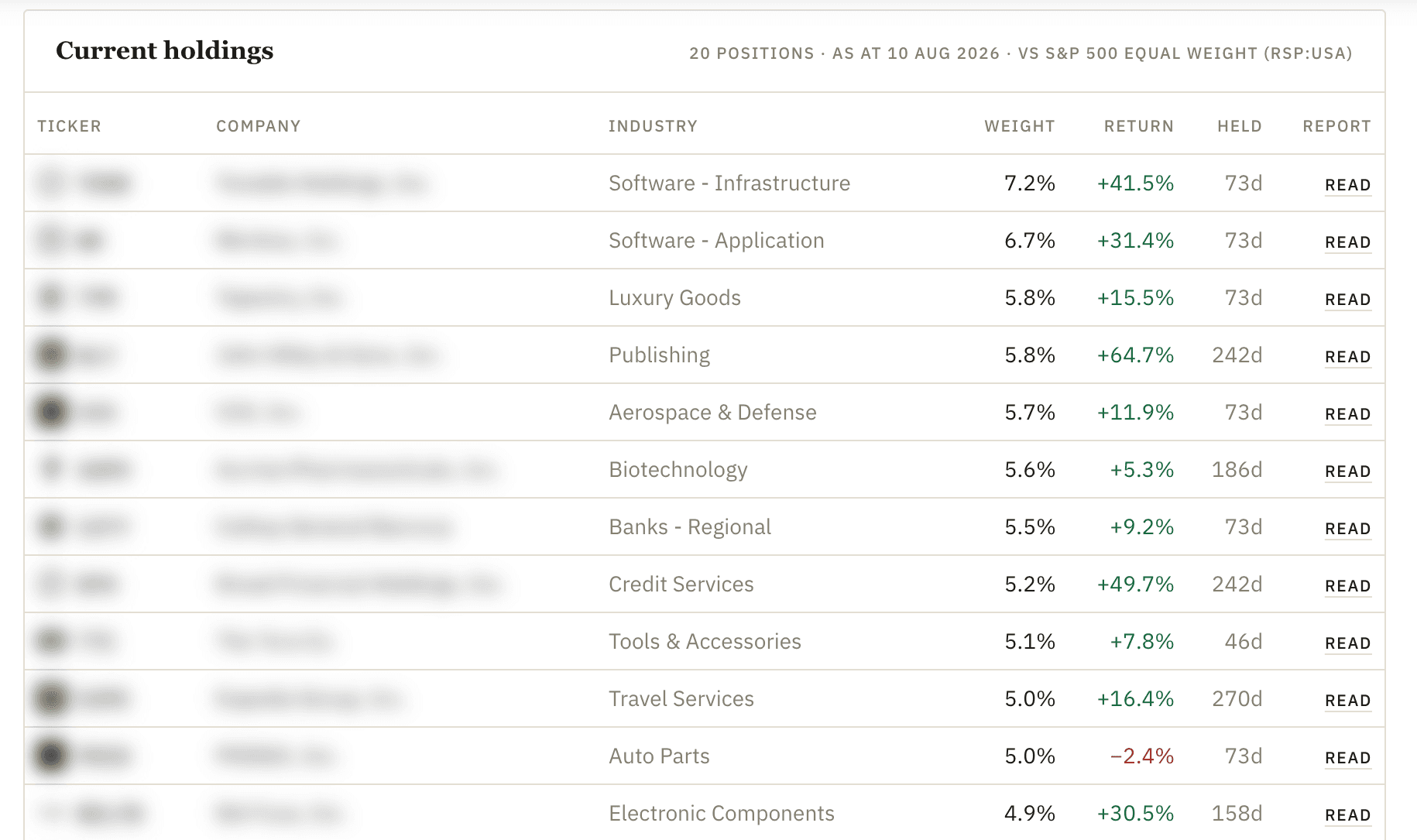
The current twenty, as members see them, blurred here because the names are what a member pays for.
Price: $199 a year or $39 a month, with a 30-day money-back guarantee.
What you get: the twenty holdings with weights, a brief per stock, and the trade log. After each four-weekly review a note says what changed, or, more often, that nothing did.
Where it differs on this page's tests: it publishes its method, lists every trade, and reviews a whole portfolio on one fixed date every four weeks. Of the others, only AAII's model portfolio does all three, quarterly and in very small value stocks. Alpha Picks and Motley Fool add two picks a month to a growing list. Ticker Nerd is one twenty-stock portfolio. The methodology explains how the rules were built and tested.
Where it falls short: its live record is the shortest on this page. The portfolio has traded live since 20 July 2026, and every trade since that day is listed for members. Everything before it is a backtest, meaning the same rules run on past data, and is labelled as such. The record and its basis are on the join page. No return figure appears on this page; the basis matters more than the number.
Who it suits: a reader who wants the decisions made by rules and the whole portfolio managed. That reader must also hold it through the months when it lags. It is the wrong choice for anyone who enjoys picking stocks or wants to trade often; services 4 and 6 fit that reader.
See the twenty-stock portfolio: $199 a year, 30-day money-back
2. Alpha Picks by Seeking Alpha: best for long-term investors
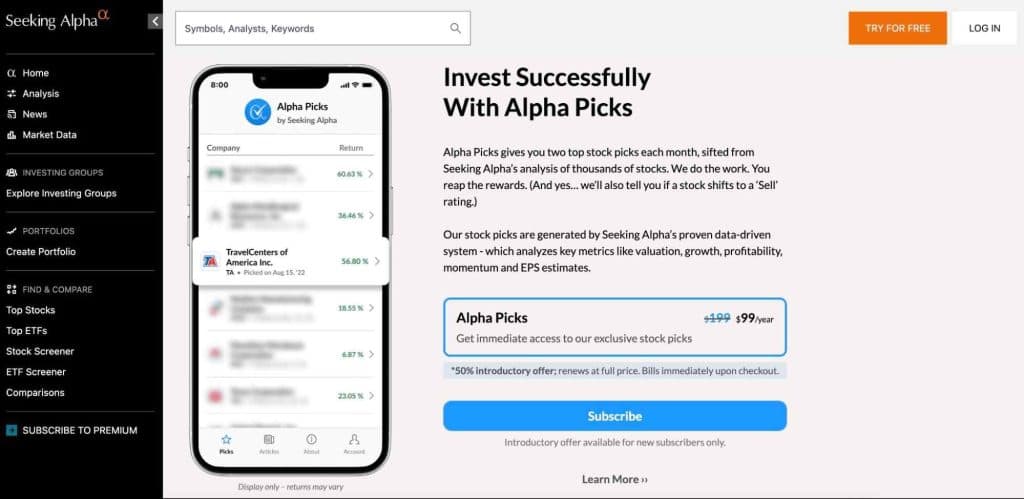
Alpha Picks is the most rule-driven of the mainstream services. Twice a month it picks one stock from Seeking Alpha's quant ratings, which are scores computed from the numbers with no analyst involved. The rules are fixed. A pick needs a Strong Buy quant rating held for at least 75 days in a row. It must also clear floors on market value and share price, and not have been picked in the past year. Sell alerts follow the same rules.
Price: $499 a year at list; $449 for the first year through our link, renewing at list. Annual only, no free trial, and the year is charged up front. Seeking Alpha's terms say subscription fees are non-refundable. Checked September 2026; refund terms checked October 2026.
What you get: two picks a month with the quant case for each, the running model portfolio, and sell alerts. The Premium + Alpha Picks bundle adds the research platform for less than the two bought separately.
Seeking Alpha also runs Quant Growth & Income, a rules-based portfolio of up to 30 dividend-paying stocks, at the same $449 for the first year and $499 after. It rebalances every two weeks and is measured against Vanguard's high-dividend fund. It launched on 3 June 2026, so its record is too short to judge.
The record and its basis: a model portfolio tracked since the launch on 1 July 2022, computed on Seeking Alpha's own method, with the S&P 500 shown alongside. The strategy page states the rules; read it before the headline figure. The record assumes every pick was bought and every sell alert followed, with no end date.
Who it suits: a long-term, data-driven investor with the discipline to follow the system exactly. Our full review: Alpha Picks by Seeking Alpha.
3. Motley Fool Stock Advisor: best for beginners
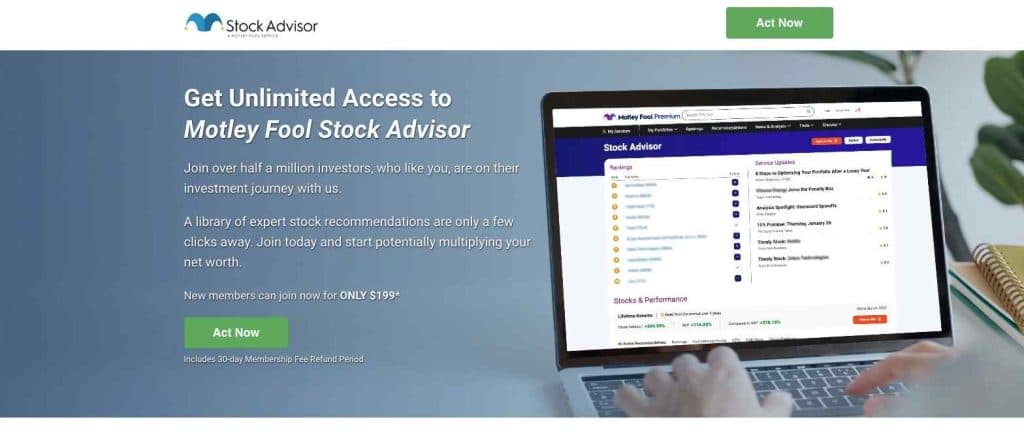
Stock Advisor has published two analyst picks a month since 2002, each with a short readable report. Its system asks members to hold 25 or more stocks for five years or longer. It is the household name of the category and has the longest unbroken public record in it.
Price: $199 a year at list; $99 for one year, $149 for two or $199 for three for new members through our link. Each renews at the then-current list price when the term ends. Motley Fool's order page includes a 30-day membership-fee refund period: cancel within 30 days and the fee is returned. Prices checked September 2026; the refund period checked October 2026.
What you get: the two monthly picks, ranked lists of current favourites and starter stocks for a first portfolio, sell notices, and the members' research library.
The record and its basis: every recommendation since 2002, each with the same weight, with the S&P 500 alongside over the same period. Motley Fool also publishes the figure without its three largest winners. That is the most useful disclosure any service on this page makes: it shows how much of the record came from holding NVDA, NFLX and AMZN through years of doubt. Our hands-on review covers the platform and the model portfolios that make the system one a person can follow.
Who it suits: a beginner or a busy investor who wants a named pick with a reason and will diversify as the system asks.
4. Seeking Alpha Premium: best for picking your own stocks with data
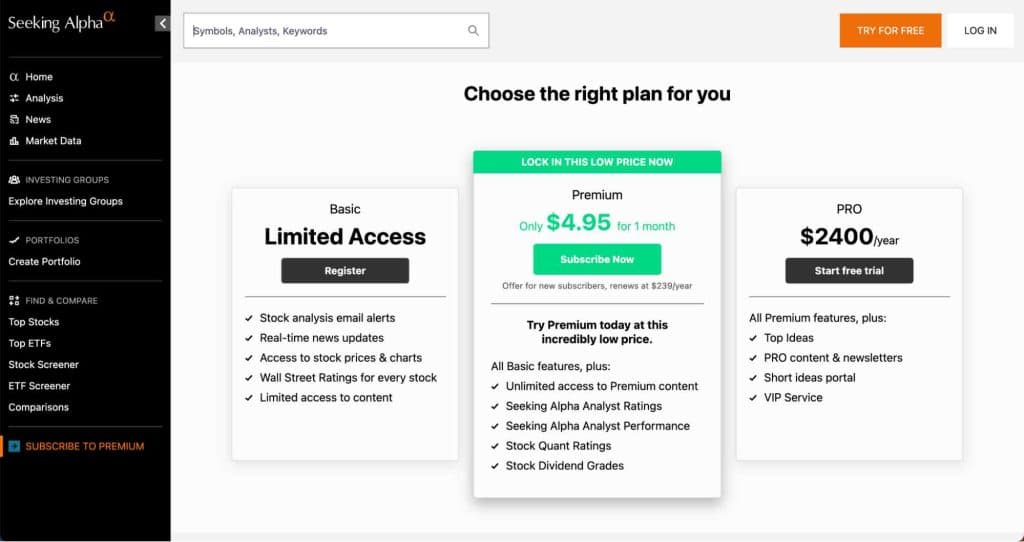
Premium is for the investor who wants to make the picks personally, with real data behind each one. Every stock has a quant rating, a score computed from the numbers, with Wall Street and contributor ratings beside it. Contributors are the site's own writers. There are factor grades, which are letter grades on things like value and growth, and screeners built on them. And there is a decade-plus archive of contributor research, where every author's record sits next to their articles.
Price: $299 a year at list; $269 for the first year through our link with a 7-day free trial for new subscribers, renewing at list. There is no refund after the trial. Seeking Alpha also sells Pro at $2,400 a year, built for professionals and very large portfolios. Our Pro review explains what the extra money buys; for most individuals Premium is the right tier. Checked September 2026.
What you get: the ratings and grades, the screener, unlimited articles and earnings-call transcripts, and portfolio tools that sync with your broker. The free tier gives headlines, a limited number of articles and basic quotes, without the ratings.
The record and its basis: Seeking Alpha publishes the performance of its Quant Rating grades over time. There is no pick record, because Premium makes no picks. The closest substitute is author accountability: you can see whether the person urging you into a stock has been right before.
Who it suits: a self-directed investor who wants data of the kind professionals use, under their own judgment. Full review: Seeking Alpha Premium.
5. Morningstar Investor: best for written research on stocks and funds
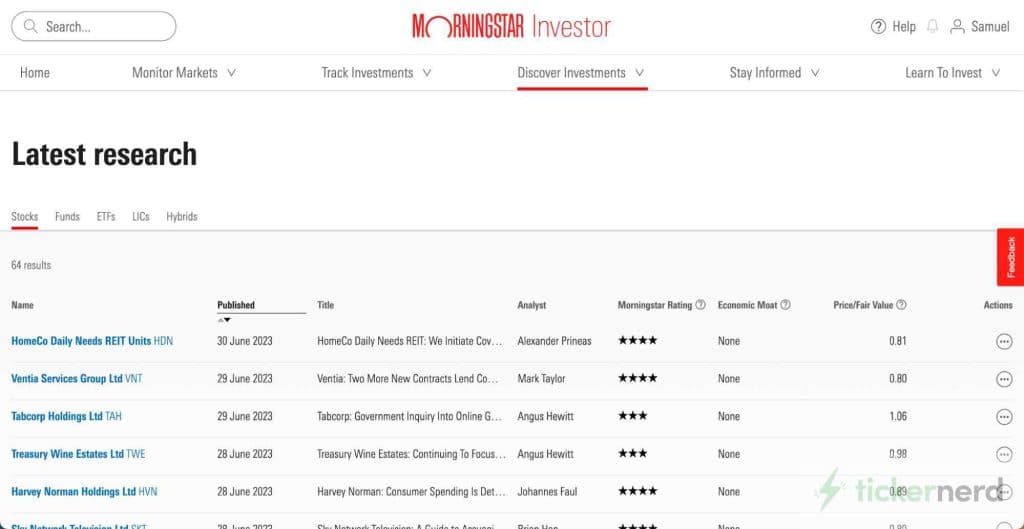
Morningstar Investor picks nothing. It is here because many people comparing picking services want what Morningstar sells. That is the deepest written research available at a retail price, with a fair-value estimate and star rating on every covered stock. A fair-value estimate is the analyst's view of what the stock is worth. It also has portfolio tools, including the X-Ray view of how your money is spread, which no rival matches.
Price: $249 a year or $34.95 a month, with a 7-day free trial, one per person. Morningstar's user agreement says prepaid subscriptions are non-refundable. Checked September 2026.
What you get: analyst reports on thousands of stocks and funds, the ratings, screeners with more than 200 data points, watchlists and portfolio X-Ray.
The record and its basis: none for picks, because there are none. The star ratings' record against benchmarks is mixed, so treat them as one input. The written reports are the product.
Who it suits: a hands-on researcher with a diversified portfolio. Full comparison: Morningstar vs Motley Fool.
6. Zacks Premium: best for screening with a ranking signal
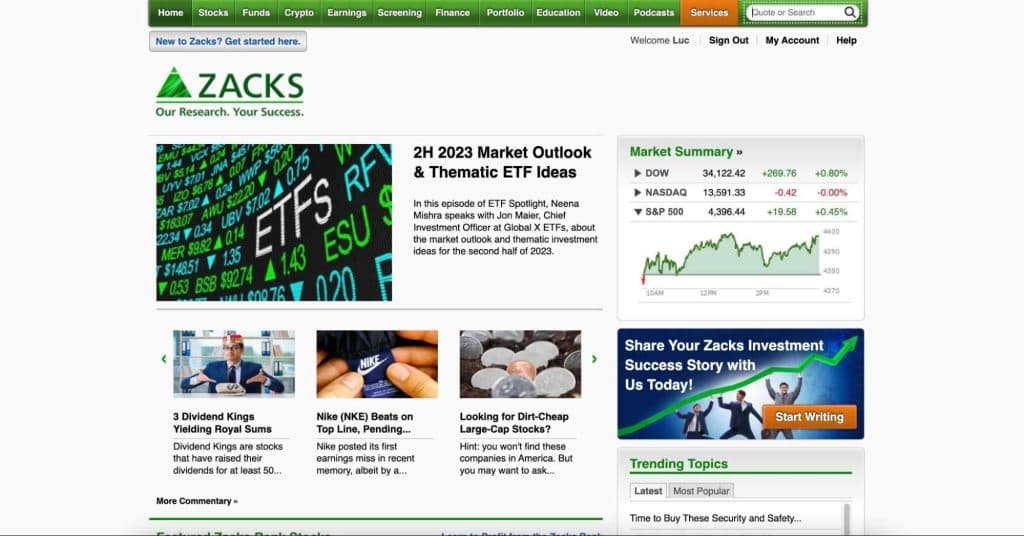
Zacks Premium is a ranking system you drive yourself. The Zacks Rank is built on changes in analysts' earnings forecasts, a signal with published research behind it. Premium adds the #1 Rank list, industry ranks, premium screens, equity research reports and the 50-stock Focus List. Nothing arrives curated; you dig.
Price: $249 a year, after a free trial. The order page promises a full refund on any payment cancelled within 90 days. Prices checked September 2026; refund terms checked October 2026.
What you get: the daily rank on every covered stock, the #1 list, style scores, screens and the Focus List portfolio.
The record and its basis: Zacks publishes the Zacks Rank #1 list's performance since 1988 against the S&P 500 in its performance disclosure. Read it knowing the list changes daily, which no private investor copies. So the published figure describes the signal, not any portfolio a person held.
Who it suits: a do-it-yourself investor who wants a screening signal inside their own process.
7. AAII Model Shadow Stock Portfolio: best for value investors on a budget
AAII is the American Association of Individual Investors, a non-profit membership body. Membership includes its Model Shadow Stock Portfolio, which picks stocks by fixed rules. A stock can join when its price is at most 0.9 times its book value, meaning what its assets are worth on the company's books. Its market value must also be between $30 million and $400 million. Financial and utility stocks are left out.
A holding is sold at a quarterly review once its price reaches 2.7 times book value or its market value reaches $1.2 billion, if a replacement qualifies. Few holdings change in a year: turnover was 9% in 2025.
Price: $49 a year, $89 for two years or $99 for three, after a $1 trial for 30 days. AAII offers a 365-day money-back guarantee. Checked October 2026.
What you get: the portfolio and every transaction in it, an update after each quarterly review, a daily list of stocks that pass the rules, and the AAII Journal.
The record and its basis: a model portfolio run on the same rules since 1993, the longest rule-based record on this page. AAII publishes the transactions and compares the result with Vanguard's S&P 500 and small-company index funds in its portfolio updates.
Who it suits: a patient value investor on a small budget, happy to own companies too small for most funds. Few shares of these companies trade each day, so prices can jump and a large order can move them. It is the wrong choice for anyone who wants large, familiar names.
See AAII membership: $49 a year, 365-day money-back.
What is a stock picking service?
A stock picking service is a paid subscription that names stocks to buy and tells you when to sell them. It is also sold as a stock advisory service or a stock advisor subscription. The good ones keep a dated log of every pick, so the record can be checked.
The services differ in who chooses. At Motley Fool it is an analyst team. At Alpha Picks, AAII and Ticker Nerd it is a set of published rules. Research sites such as Seeking Alpha Premium and Morningstar name no picks; they give you data to choose with.
Best free stock picking service
No free service keeps a full portfolio for you. Three free tiers come closest:
- Zacks shows the Zacks Rank, a 1-to-5 rating, on every covered stock's free quote page. It is the nearest free thing to a pick, though nobody tells you when to sell.
- Seeking Alpha's free tier gives headlines, a limited number of articles and basic quotes. The quant ratings and factor grades need Premium.
- Ticker Nerd's free stock pages show the model's rank on every covered stock. The twenty holdings, and when they change, are for members.
The free trials are the other way to look before paying. Zacks, Seeking Alpha Premium and Morningstar each offer one, and AAII charges $1 for 30 days. Motley Fool and Ticker Nerd offer 30 days to get your money back instead.
Best stock advisor service: which one?
The answer is Motley Fool Stock Advisor. A stock advisor service, in the sense searchers mean it, names a stock and tells you why. Stock Advisor has done that twice a month for 24 years with a record that counts every pick. Three years for $199 works out at about $66 a year. The 30-day refund period removes the risk of finding out it is not for you.
Choose Alpha Picks instead if you want a rule choosing the stocks. Choose Ticker Nerd if you want the picks and the portfolio decided together.
Best stock advice sites and websites
"Stock advice site" is what many searchers type for any site that names stocks. The best of these keep a public log of every position. By that test three make the cut outside our own. Motley Fool Stock Advisor names analyst picks, Alpha Picks names picks chosen by rule, and AAII runs a rule-based value portfolio. Ticker Nerd, ours, keeps the same kind of log for a rules-run portfolio. Seeking Alpha Premium and Morningstar Investor are research sites; they help you form your own view and name no picks.
If you are choosing your first one, go by cost against portfolio size. A first year of Motley Fool at $99 is 1% of a $10,000 portfolio, and three years for $199 is about $66 a year. AAII at $49 is half of 1%. Alpha Picks at $449 is 4.5% of the same portfolio, which asks for a bigger account before the fee makes sense.
How we tested and ranked
The seven are the ones I rate; nothing appears for a commission. Each was scored on three tests, all three about the record. The interface did not count.
- Every pick counted, losers included. From the day the service started, with no highlight reels and no "last twelve months" windows.
- The benchmark alongside. The S&P 500 over the same period, in the same place, so a return figure means something.
- A system a person could follow. A fixed number of positions, a stated holding period and a set date for reviewing the holdings. A list that changes daily fails this test however good the signal.
Alpha Picks, Motley Fool and AAII pass all three; AAII's record, from 1993, is the longest. Ticker Nerd passes all three too, with the shortest live record here: it began on 20 July 2026. Seeking Alpha Premium and Morningstar make no picks, so they are ranked on what they give your own process. Zacks fails the third test by design.
Fee against portfolio came next. $199 a year guiding a $25,000 portfolio costs 0.8% a year. The same fee against $2,000 costs 10%, which no research earns back. Do that division before comparing features.
Refund terms came last, because they say something about confidence. AAII gives the longest window: 365 days to get the fee back, after a $1 trial. Ticker Nerd and Motley Fool give 30 days. Zacks refunds any payment within 90 days, after a free trial. Seeking Alpha Premium and Morningstar offer a 7-day free trial and no refund after it. Alpha Picks charges the year up front with no trial and no refund.
Stock picking services vs investment newsletters
A stock picking service sells a decision and keeps a log. An investment newsletter sells reading, and most keep no log at all. The confusion is commercial. Newsletters call themselves picking services because the word sells, and a few picking services publish enough commentary to read like newsletters.
The test is the log. If every position the publisher has ever named sits in a public record with a date, judge it by the three tests above. If not, it is a newsletter. Our best investment newsletters page ranks that field by what the reading is worth.
Verdict: the best stock picking service in 2026
Alpha Picks, for a reader who will follow it. Its picks come from a stated rule. Its portfolio has been tracked since July 2022 on a published method, with the benchmark alongside. Two picks a month held for a year or more is a system a person with a job can run. The price is the objection: $449 for the first year and $499 after, with no trial. So it wants a portfolio large enough to make that fee small.
Motley Fool Stock Advisor is the verdict for a beginner, or for anyone who wants the reason in words rather than a rule. It passes the same three tests, at $99 for the first year with 30 days to change your mind.
Ticker Nerd is ours, and it is for the reader who wants the whole portfolio decided: twenty stocks by rule, reviewed every four weeks, with every trade published. Its live record is the shortest here. Every record on this page assumes the system was followed completely, so choose the one you will follow.
See the twenty-stock portfolio: $199 a year, 30-day money-back
Quick answers.
Who has the best stock picking record?
No single answer holds, because each service measures its record on a different basis. Motley Fool Stock Advisor counts every recommendation since 2002, each with the same weight, against the S&P 500. Alpha Picks reports a model portfolio tracked since its July 2022 launch on Seeking Alpha's own method. Zacks reports the Zacks Rank #1 list since 1988, but that list changes daily and nobody trades it as published. AAII's Model Shadow Stock Portfolio has run on fixed rules since 1993, the longest record of the seven, as a model portfolio. Ticker Nerd publishes every trade since its model went live on 20 July 2026 and labels everything earlier as a backtest, a test on past data. The best record counts every pick, losers included, shows the benchmark next to it, and describes a system a person could have followed.
How do stock picking services work?
You pay a subscription, usually $199 to $499 a year. The service names the stocks its process favours, by email or a member dashboard, and sends a sell notice when the process drops one. The process is the real difference. Motley Fool uses analyst conviction. Alpha Picks uses quant ratings, which are scores computed from the numbers. Ticker Nerd uses published rules over a ranked list of stocks. Zacks gives you a rank to screen yourself. Every published record assumes you followed the whole process, so choose the service whose process you will run.
Is there a free stock picking service?
Not one that keeps a full portfolio for you. The closest free option is Zacks: its free quote pages show the Zacks Rank, a 1-to-5 rating, on every covered stock. Seeking Alpha's free tier gives headlines and a limited number of articles, without the quant ratings. Ticker Nerd's free stock pages show its model's rank on every covered stock; the twenty holdings are for members. The cheapest paid option here is AAII at $49 a year, after a $1 trial. Zacks, Seeking Alpha Premium and Morningstar offer a free trial first.
Are stock advisor subscriptions worth it?
Only when the fee is small against the money it guides and you follow the system completely. A $199 subscription is 0.8% a year on a $25,000 portfolio and 10% on $2,000, which no research earns back. Motley Fool's own disclosure shows why following only part of a system fails. Its average return since 2002 fell by roughly two-thirds once three winners were removed. So the reader who bought a handful of picks did not get the published record.
What does a stock advisor subscription cost?
Between $199 and $499 a year for the mainstream services, checked in September 2026. Motley Fool Stock Advisor lists at $199 a year. New members pay $99 for the first year, or $199 for three years, through an affiliate link. Morningstar Investor and Zacks Premium are $249 a year. Seeking Alpha Premium is $299 a year, or $269 for the first year through an affiliate link. Alpha Picks is $499 a year, $449 for the first year. Ticker Nerd is $199 a year or $39 a month. AAII membership, which includes its rules-based Model Shadow Stock Portfolio, is $49 a year.
What are the best stock advice sites?
Motley Fool Stock Advisor is the site for named picks with a written reason; it has published two recommendations a month since 2002. Alpha Picks by Seeking Alpha is the site for picks chosen by rule. Seeking Alpha Premium is the site for making your own picks with real data. Morningstar Investor has the best written research of the group but publishes no picks. Zacks Premium sells a ranking you screen yourself. AAII publishes a rules-based portfolio of small value stocks for $49 a year. Ticker Nerd, our own service, publishes a twenty-stock portfolio run by rules.
How do you judge a stock picking record?
Three tests. First, every pick is counted, losers included, from the date the service started. Second, the benchmark sits alongside, over the same period, so the return means something. Third, the record describes a system a person could have followed: a fixed number of positions, a stated holding period and a set date for reviewing the holdings. A record fails at least one test if it shows only winners, only the last twelve months, or a list that changes daily.
Which stock picking service is best for beginners?
Motley Fool Stock Advisor. It gives two picks a month with a short readable reason, and a starter list for a first portfolio. New members pay $99 for the first year, with a 30-day membership-fee-back guarantee. Its system asks for 25 or more stocks held for five years or longer, which is the discipline a beginner most needs. Ticker Nerd suits a beginner who would rather not choose stocks at all, because the rules run the whole portfolio.
The market re-ranks every week. Monday's email says what moved.
Computed off the Friday close and sent before the US open.
Market Radar reports the week’s largest rank changes across roughly 4,600 US stocks, the factor behind each one, and where the market went.