Motley Fool Stock Advisor Review (2026): Is It Worth $199?
Stock Advisor is $199 a year, $99 for the first year through our link. What two picks a month buy, how the Fool's record is built, and who should skip it.
 By Aslam Ghouse, CFA · Ex-Goldman Sachs systematic trader · Updated 16 Sept 2026
- Our rating
- 4.0 / 5
- Price
- $199 a year list; new members: $99 for one year, $149 for two, $199 for three through our link; renews at list
- Refund
- 30-day membership-fee-back guarantee, no questions asked
- Best for
- Long-term investors with $25k or more who will buy every pick and hold for five years
We earn a commission if you subscribe through this link, at no extra cost to you. It has no bearing on what the model ranks or what we cover.
Some links in this article are affiliate links. How we get paid · How we review.
Motley Fool Stock Advisor costs $199 a year at list. New members pay $99 for the first year, $149 for two years or $199 for three through our link. It has sent two stock picks a month since February 2002. By the Fool's own scoreboard the average pick has returned +950% against +212% for the S&P 500 as of 16 September 2026. That figure gives every pick equal weight and includes dividends. Prices and terms below were checked on fool.com on that date.
My take: Stock Advisor is worth $99 for a first year if you have $25,000 or more, will buy every pick, and will hold each one for five years. If you already know you will follow that five-year plan, the three-year term at $199 is the cheaper path. It is a poor buy if you plan to skim the list for two or three exciting names, because the record only exists across the whole list.
The membership renews at list price when the term ends, so set a reminder before then. On a trading desk I learned to read a track record for its shape before its size. The shape of this one is a handful of enormous winners carrying hundreds of ordinary picks. That shape decides whether the service will work for you.
What is Motley Fool Stock Advisor
The Motley Fool was founded in 1993 by brothers Tom and David Gardner as a print newsletter in Alexandria, Virginia. Stock Advisor is its entry-level subscription and its best-known product. The company says more than half a million members subscribe.
The service is a recommendation letter. Each pick arrives with a written case that covers the business, its strengths, what is helping it grow, and the risks. The pick then sits on a public scorecard, where its return is tracked against the S&P 500 from the day it was issued.
Two analyst teams share the work. The Hidden Gems team looks for quality companies of any size that the market has yet to price properly. The Rule Breakers team looks for first movers in new sectors, often when the shares already look expensive. Rule Breakers was once sold on its own. Since the 2025 restructure it is a team inside Stock Advisor and a separate scorecard inside Epic. So "Rule Breakers vs Stock Advisor" is no longer a choice you have to make.
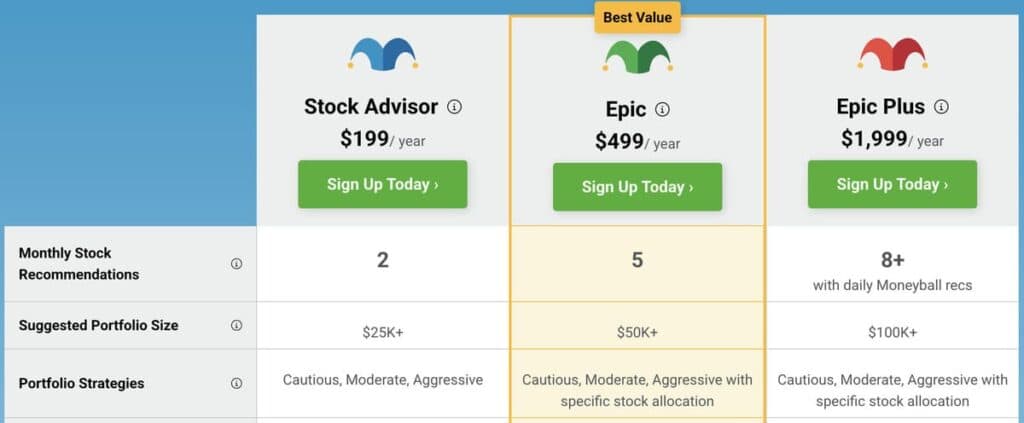
The five Motley Fool tiers. Stock Advisor is the cheapest; everything above it includes it.
Motley Fool Stock Advisor cost (2026): $99, $149, $199 and the Epic ladder
There is one billing option per tier: annual, paid up front. No monthly plan exists. Every figure below is from fool.com's service pages, checked September 2026.
| Tier | List price | New-member offer | Picks a month | Suggested portfolio | Guarantee |
|---|---|---|---|---|---|
| Stock Advisor | $199/yr | $99 / 1 yr · $149 / 2 yrs · $199 / 3 yrs | 2 | $25k+ | 30-day fee back |
| Epic | $499/yr | $299 with code EPICSALE | 7 | $50k+ | 30-day fee back |
| Epic Plus | $1,999/yr | $1,399 | 8+ | $100k+ | 30-day credit swap |
| Fool Portfolios | $3,999/yr | Promotional pricing | 10+ | $250k+ | 30-day credit swap |
| Fool One | $13,999/yr | Promotional pricing | 10+ | $500k+ | 30-day credit swap |
Every term renews at the list price of the day when it ends. That is stated in the Fool's own footnote. The Fool's own comparison page shows all five tiers with their new-member prices side by side.
- Stock Advisor is the right tier for almost everyone reading this. The two picks, the rankings and the model portfolios are the product.
- Epic makes sense once a portfolio passes $50,000 and you want the Fool to size positions for you. The Epic Portfolio states how much to put in each stock; Stock Advisor does not. Our Epic link reaches the new-member page, where the code EPICSALE takes $200 off the $499 list price. The checkout shows the exact figure.
- Epic Plus, Fool Portfolios and Fool One are for six-figure portfolios. They add real-money portfolios, options, research on very small companies, and the hand-holding the price implies. If you are asking whether Stock Advisor is worth $199, none of these is for you yet.
On discounts: our link offers new members three terms: $99 for the first year, $149 for two years or $199 for three. Three years works out to $66 a year. The one-year path costs $99, then $199 a year. Take one year to test the service. Take three if you intend to follow the five-year plan. The $49 rate seen on third-party pages is not on fool.com in September 2026.
New members only: $99 for one year, $149 for two or $199 for three. Renews at the list price, $199 a year, when the term ends. 30-day membership-fee-back guarantee.
Get 50% off Stock Advisor for the first yearIs Motley Fool worth it?
Put the fee against the portfolio. At $199 a year on the suggested $25,000 minimum, Stock Advisor costs 0.8% of the money it is guiding. That is in line with an actively managed fund's fee. On $10,000 it is 2%, which is expensive for two ideas a month. On $100,000 it is 0.2%, and at that size the Fool will steer you toward Epic anyway.
The second question is whether you will follow the system. The Fool's scoreboard averages every pick, so it describes an investor who put equal money into each one and held for years. Someone who buys the five most interesting names owns a different portfolio with a different outcome. The published figure tells them nothing about it.
Worth it if you have $25,000 or more and want an analyst's written case to read every two weeks. The plan is to build toward 25 or more holdings over a few years and leave them alone.
Skip it if your money is in index funds and you are happy with that. The same goes if you want to trade over weeks or months, or if you already know you will only buy the picks you like the sound of.
Is Motley Fool legit?
The business facts are plain. The Motley Fool was founded in 1993 and is based in Alexandria, Virginia. Co-founder Tom Gardner runs it as chief executive, and it has Australian and Canadian editions. Stock Advisor has published without a break since February 2002. The scorecard is public: every pick, its date, its return and the S&P 500's return over the same period.
The record is stated with its basis, which is more than most of the newsletter industry manages. The basis also explains the complaints. Every pick since 2002 counts equally in the average. So a few picks made before 2010, which have grown for fifteen years or more, carry the average. The Fool's own December 2025 scoreboard showed the average falling to roughly a third of the headline once Nvidia, Netflix and Amazon were removed. That is the payoff shape of stock picking, published honestly. Read the headline number knowing it.
The other complaint is marketing. The Fool sells five tiers and Stock Advisor is the entry. So the pitch for Epic starts on the checkout page and continues in the member emails. There is also a steady flow of promotional mail for other products. None of it is deceptive. It is loud, and an email filter rule solves it.
What you get for the money
Two picks a month, on a fixed schedule. The Hidden Gems team's pick lands on the first Thursday and the Rule Breakers team's pick on the third Thursday. Each comes as an article with the case for the company and the risks. Each also carries a Cautious, Moderate or Aggressive tag that says what kind of investor it suits.
On the fourth Thursday both teams update the Top 10 stock rankings. These are the ten names the analysts would buy today from everything on the scorecard. The rankings are the Fool's answer to "I have new money this month, where does it go".
The Foundational Stocks list is ten buy-and-hold names spread across sectors and risk levels, refreshed every quarter. It gives a new member a base before the monthly picks start arriving.
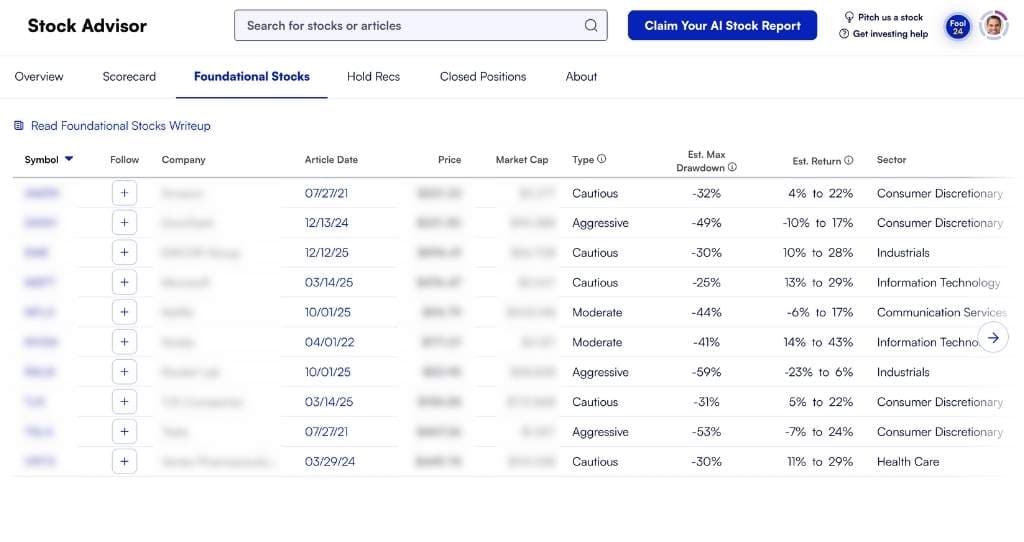
The Foundational Stocks list inside Stock Advisor.
The three portfolio strategies are the feature I rate highest. Each one (Cautious, Moderate, Aggressive) shows how to combine the foundational names, the top-ranked names and the new picks with a set of ETFs. A member who does not want to build a portfolio one pick at a time has a template to follow. The Aggressive strategy still holds a meaningful share in ETFs. The Fool is more measured in practice than its marketing sounds.
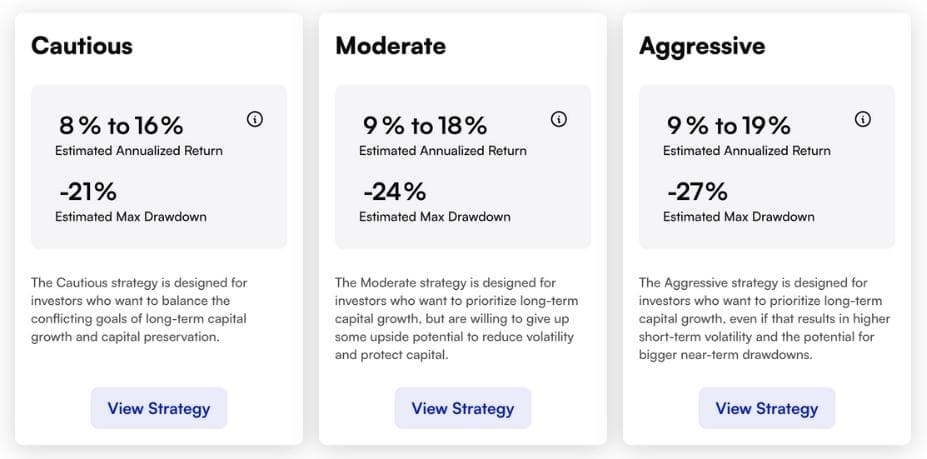
The three strategies. They differ on expected return against expected worst fall.
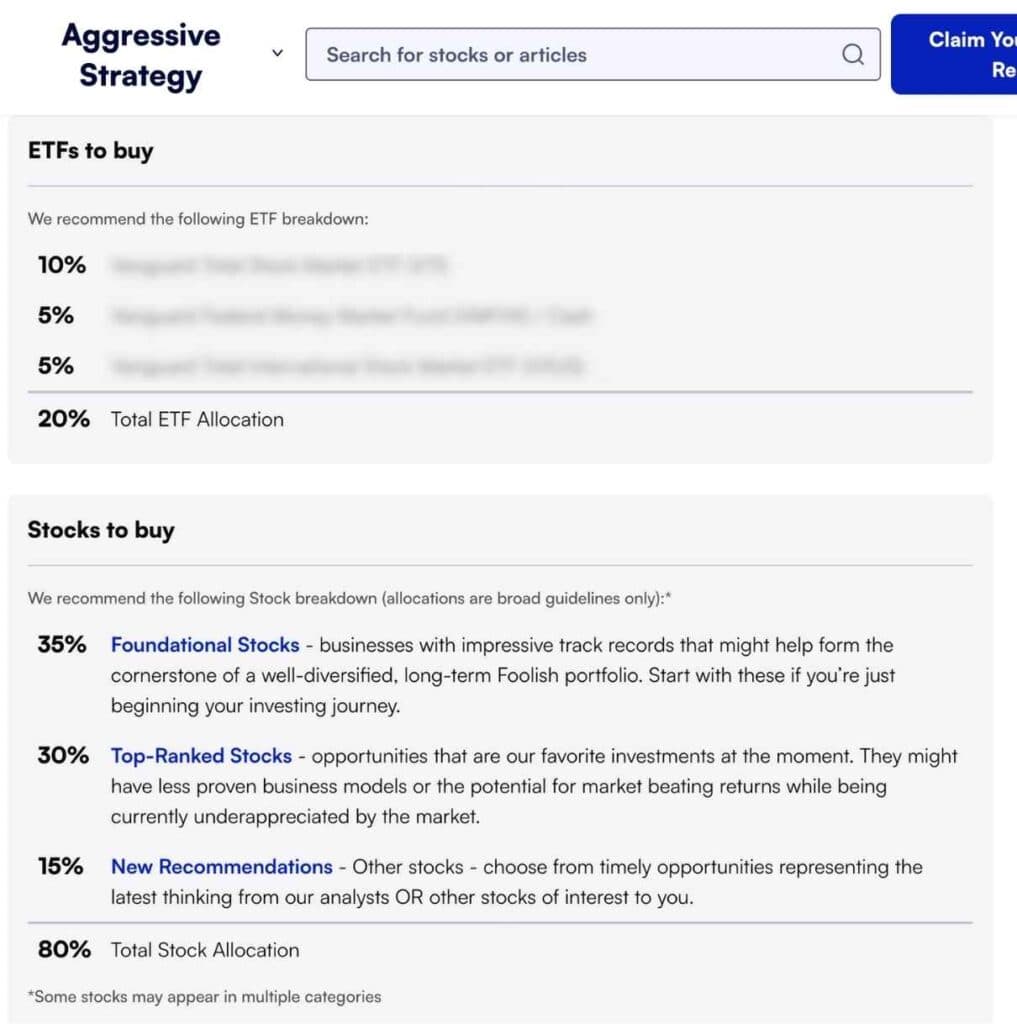
The Aggressive strategy: ETFs and stocks, with the mix stated.
Around the picks sit the tools. Fool IQ shows a quality, growth, value and safety score for each stock, with the financials and the analysts' notes. Stock Advisor gets partial access; Epic gets all of it. Moneyball is the Fool's data-driven scoring system, topped with a Superscore for ranking. It is partial on this tier too, as is GamePlan. There is a watchlist and portfolio tracker, Fool24 live market coverage, and the articles, podcasts and videos that come with any Fool membership.
Sell recommendations are rare. The house rule is to hold for five years or more, and most names on the scorecard have been open for years. When the case for a stock weakens, the analysts usually move it to hold first; the scorecard calls this the "penalty box". When the case breaks they issue a sell. If you want a service that manages exits for you on a timetable, that is a different product. The Ticker Nerd section below is about one.
Two picks a month, the Top 10 rankings and the three model portfolios. Renews at the list price, $199 a year, when the term ends.
Join Stock Advisor for $99, or $199 for three yearsWhere Stock Advisor falls short
- The record is concentrated. A few early winners carry the average, so the headline return describes a portfolio almost nobody held in full. Judge the service on the process and the current rankings. Treat the scoreboard as context.
- No position sizes. Stock Advisor tells you what to buy and never how much. Sizing comes with Epic, at $499 list. The three strategies partly fill the gap with their ETF-and-stock mixes.
- Exits are your problem. Sells are rare, so a member who wants to trim a winner or cut a loser decides alone. The Fool's answer is that you should not want to. That is a philosophy, and one you have to share.
- The renewal is the real price. $99 buys the first year and $199 buys three. Either way the term renews at list, $199 a year today. Put the date in your calendar.
- The tools are throttled on this tier. Fool IQ, GamePlan and the Moneyball rankings are partial on Stock Advisor. The full versions cost $499.
- The marketing is relentless. Five tiers up to $13,999, and every one of them will be offered to you.
Motley Fool vs Seeking Alpha
Searchers compare them all the time, and they are barely competitors. Stock Advisor is a picks service: it tells you what to buy and why. Seeking Alpha Premium is a research platform. It has computer-scored (quant) ratings on thousands of stocks, contributor articles arguing both sides, earnings call transcripts and a screener to filter stocks by the numbers. The decision is left to you. Premium lists at $299 a year against Stock Advisor's $199.
The like-for-like comparison is Stock Advisor against Alpha Picks, Seeking Alpha's picks product. Alpha Picks chooses two stocks a month from its quant ratings rather than from analyst conviction. Stock Advisor has the longer public record and a written case per pick. Alpha Picks has rules-based selection and a much shorter history. Seeking Alpha Premium is for the reader who wants to decide. The two picks services are for the reader who wants to be told.
- Public scorecard since 2002 with the S&P 500 beside every pick
- Two picks a month on a fixed schedule, each with a written case
- Top 10 rankings and a Foundational Stocks list answer the question of where new money goes
- Three model strategies mixing the picks with ETFs, for members who want a template
- $99 for the first year, or three years for $199, with a 30-day fee-back guarantee: cheap to try
- The average return is carried by a handful of early winners
- No position sizes on this tier; sells are rare and exits are left to you
- Renews at $199 a year after the introductory term
- Fool IQ, GamePlan and Moneyball are partial on Stock Advisor
- Heavy marketing and a constant push toward Epic
Motley Fool Stock Advisor vs Ticker Nerd
Different jobs. Stock Advisor hands you ideas to build a portfolio from over years. Ticker Nerd hands you a finished portfolio that rules maintain.
| Motley Fool Stock Advisor | Ticker Nerd | |
|---|---|---|
| What you get | Two analyst picks a month, rankings, model strategies | The Ticker Nerd 20, a rules-run portfolio of twenty stocks |
| Who decides | The Hidden Gems and Rule Breakers analysts; you assemble the portfolio | Published rules over a ranked ~1,500-stock universe; the model buys and sells |
| Cadence | Two picks a month, sells when a thesis breaks | Reviewed every four weeks, with a plain-English brief per holding |
| Record | Public scorecard since 2002, every pick equal-weighted against the S&P 500 | On the join page: every trade since live, losers included |
| Price | $199/yr list; $99 the first year for new members | $199/yr |
The short version: if you enjoy reading an analyst's case and want to build toward 25 holdings over a few years, choose Stock Advisor. It is the established product with the long record. If you want the portfolio decided and maintained by rules from day one, that is what membership is. Plenty of members run both. They read the Fool and put the money in the model.
Verdict: is Motley Fool Stock Advisor worth it in 2026?
Yes, at $99 for a first year, for the investor it was built for. That investor has $25,000 or more, will buy every pick in equal amounts, and will leave the portfolio alone for five years. For them the service is cheap, the schedule is disciplined, and the model strategies make the system easy to follow from the first month.
Everyone else should be honest about which sentence above does not describe them. An index-fund holder gains nothing. A trader will be frustrated by the sell policy. A cherry-picker gets a random sample of the record, and the scoreboard says nothing about what that sample will do.
Renewal is $199 a year after the term, and the guarantee runs 30 days. Set a calendar reminder for the renewal date before you test it.
Quick answers.
How much does Motley Fool Stock Advisor cost?
The list price is $199 a year, checked on fool.com in September 2026. New members who join through our link choose a term: $99 for the first year, $149 for two years or $199 for three. When the term ends, the membership renews at the list price of $199 a year. There is no monthly plan and no free trial. The 30-day membership-fee-back guarantee is the way to try it.
Is Motley Fool legit?
Yes. The Motley Fool was founded in 1993 by Tom and David Gardner in Alexandria, Virginia. Stock Advisor has run without a break since February 2002. Every pick sits on a public scorecard with the S&P 500 beside it. The complaints are about the volume of marketing and the push toward pricier tiers, and both are real. The other complaint is that a few huge winners carry the record. That is true of all stock picking.
Is Motley Fool Stock Advisor worth it?
At $99 for a first year, yes, for a long-term investor with $25,000 or more who will buy every pick and hold each for five years. That is the plan the published record assumes. Anyone set on that plan should take the three-year term at $199, which is $66 a year. It is a poor fit if you hold index funds only, trade over weeks, or plan to pick two or three names from the list.
What do you get with Stock Advisor?
Two stock picks a month, each with a written case. The Hidden Gems team sends one on the first Thursday and the Rule Breakers team sends one on the third. On the fourth Thursday both teams update a Top 10 ranking. Members also get a Foundational Stocks list of ten buy-and-hold names, refreshed every quarter. Three model portfolio strategies (Cautious, Moderate, Aggressive) mix the picks with ETFs. There is also a watchlist, a portfolio tracker and partial access to the Fool IQ and GamePlan tools.
Does Motley Fool tell you when to sell?
Rarely. The house style is to hold for at least five years, so most picks stay open for years. When the analysts lose faith in a stock they usually move it to hold first. They issue an outright sell when the case for the stock breaks. If you want a service that sells positions on a schedule, this is the wrong product.
What is the difference between Motley Fool Stock Advisor and Epic?
Stock Advisor is the entry tier. It lists at $199 a year ($99 the first year for new members through our link), sends two picks a month, and suggests a portfolio of $25,000 or more. Epic lists at $499 a year ($299 the first year). It includes Stock Advisor plus the Rule Breakers, Hidden Gems and Dividend Investor scorecards, seven picks a month in all. It also has an Epic Portfolio with specific position sizes, and it suits portfolios of $50,000 or more. Above Epic sit Epic Plus ($1,999), Fool Portfolios ($3,999) and Fool One ($13,999).
Can you cancel Motley Fool Stock Advisor and get a refund?
Within 30 days of joining, yes. Stock Advisor and Epic carry a membership-fee-back guarantee with no questions asked, and it applies to every introductory term. After 30 days you can cancel and keep access to the end of the paid term. Epic Plus and Fool Portfolios carry a 30-day credit swap guarantee instead of a cash refund.
Motley Fool or Seeking Alpha?
They do different jobs. Stock Advisor gives you two named picks a month and a written case to hold each one. Seeking Alpha Premium gives you computer-scored (quant) ratings, thousands of contributor articles and the tools to form your own view. Its picks product, Alpha Picks, is sold separately. If you want to be told what to buy, Stock Advisor. If you want to research and decide, Seeking Alpha.
The market re-ranks every week. Monday's email says what moved.
Computed off the Friday close and sent before the US open.
Market Radar reports the week’s largest rank changes across roughly 4,600 US stocks, the factor behind each one, and where the market went.