Morningstar Investor Review (2026): Is It Worth $249 a Year?
Morningstar Investor costs $249 a year, $199 the first year through our link, or $34.95 a month. What its stock valuations are for, and who should skip it.
 By Aslam Ghouse, CFA · Ex-Goldman Sachs systematic trader · Updated 16 Sept 2026
- Our rating
- 4.5 / 5
- Trial
- 7 days free, one trial per person, card charged when it ends
- Refund
- None. Prepaid subscriptions are non-refundable; cancel any time and access runs to the end of the paid term
- Best for
- Investors who run their own money, own funds and ETFs as well as stocks, and want an independent estimate of what each is worth before they buy
We earn a commission if you subscribe through this link, at no extra cost to you. It has no bearing on what the model ranks or what we cover.
Some links in this article are affiliate links. How we get paid · How we review.
Morningstar Investor costs $249 a year at list, $199 for the first year through our link, or $34.95 a month. Every plan starts with a 7-day free trial. For that you get Morningstar's analyst reports on the stocks its equity team covers, each with a fair-value estimate: the analyst's view of what the stock is worth. You also get its star and Medalist ratings on funds and ETFs, a screener with more than 200 data points, and Portfolio X-Ray. Prices and terms below were checked on Morningstar's own pages on 16 September 2026.
My take: Morningstar Investor is worth $199 for a first year if you own funds or ETFs beside stocks and want an independent view of what each is worth. It is the wrong buy if you want to be told what to buy, because Morningstar rates and never recommends. Put the $249 renewal date in your calendar, since there are no refunds.
On a trading desk every position had its own valuation to check the broker's number against. Most price targets a private investor sees come from brokers, and brokers also want the company's banking business. Morningstar's analysts are paid by subscribers, not by the companies they cover. They publish a fair-value estimate on every stock they cover, with an uncertainty rating beside it. That independent second opinion is the core of what you pay for.
What Morningstar Investor is, and what happened to Premium
Morningstar is a Chicago research firm. Joe Mansueto founded it in 1984 as a mutual-fund data publisher. Today it is a listed company, and its institutional business (Morningstar Direct, PitchBook, DBRS credit ratings) dwarfs its retail arm. Morningstar Investor is the retail arm: the one paid subscription sold to individuals.
The product was called Morningstar Premium until June 2022. That month Morningstar launched Investor and converted every Premium membership to it. Premium is no longer sold, so a "Morningstar Premium review" describes this product at an earlier stage. Former Premium members keep the legacy Portfolio Manager tool alongside the new Portfolio tab. Everyone else sees only Investor.
Investor is a research platform in the strict sense. It publishes an opinion on almost every listed security, as a rating and a written case, and stops there. There is no model portfolio, no buy list, and no email telling you what to do this month. Morningstar sells those separately as its newsletters, covered below.
Morningstar Investor cost (2026)
Two billing periods, one offer. Every figure is from Morningstar's own pricing and affiliate pages, checked September 2026.
| Plan | Price | What Morningstar's page says |
|---|---|---|
| Yearly, first year through our link | $199 | $50 off the list price, first year of a yearly plan only; renews at list |
| Yearly, list | $249 | Morningstar's own page shows $249, "$20.75/mo" |
| Monthly | $34.95 | $419 over twelve months |
| Renewal | $249 a year | Auto-renews at the fee in effect on the renewal date |
Every plan opens with a 7-day free trial. The trial ends at 11:59 PM Central Time on day seven, and the card is charged then. One trial per person, for life: Morningstar's terms say a second trial is never offered. The $50 offer applies only to a new yearly subscription and cannot extend an existing one. It needs a partner code, which our link carries.
Morningstar also sells discounted plans to students, teachers and US military members, verified through SheerID at checkout. The military discount lapses after year one. Students reverify every two years. The prices appear only at checkout, so I have not printed them here.
As a share of a portfolio, $249 is 1% a year on $25,000, which is what an actively managed fund charges. It is 0.5% on $50,000 and 0.25% on a $100,000 portfolio. Below $25,000 the fee is hard to justify, since the star ratings are free and many public libraries give Morningstar access on a library card. The monthly plan is for that case: one month at $34.95 to research a specific decision, then cancel.
$50 off the yearly plan for new subscribers. Renews at $249. No refunds after the trial, so cancel before day seven if it is not for you.
Is Morningstar Investor worth it?
The question is whether you will use an opinion you did not ask for. Morningstar's analysts publish a fair-value estimate on every stock they cover and a rating on every fund, whether or not the number suits you. Investors who check their own view against an independent one before buying will use this every week. Investors who want the decision made for them will log in twice and forget it.
Worth it if you hold funds or ETFs as well as individual stocks, since nobody else sells fund research this deep to individuals. It is also worth it if you run a portfolio of $25,000 or more and want to see it as one thing through X-Ray. And it is worth it if you buy stocks on the company's numbers and want a second estimate of value beside your own.
Skip it if you hold one or two index funds and are happy. Skip it if you want a service that names the stock to buy this month. That is Motley Fool's job. Skip it if you want a portfolio run for you, which is ours. Skip it if you trade over days on charts and volume, which Morningstar barely covers. And skip it if your broker already gives you Morningstar reports free, as Schwab and Fidelity do.
What you get for the money
Analyst reports and the fair-value estimate. This is the product. Each covered stock has a report written by a salaried Morningstar analyst. The report covers the business and its economic moat, Morningstar's term for how well the business is shielded from rivals. It gives the fair-value estimate and what drives it, the risks, and the analyst's view of management. The reports run long, often past 4,000 words, and read like the internal research a fund pays for.
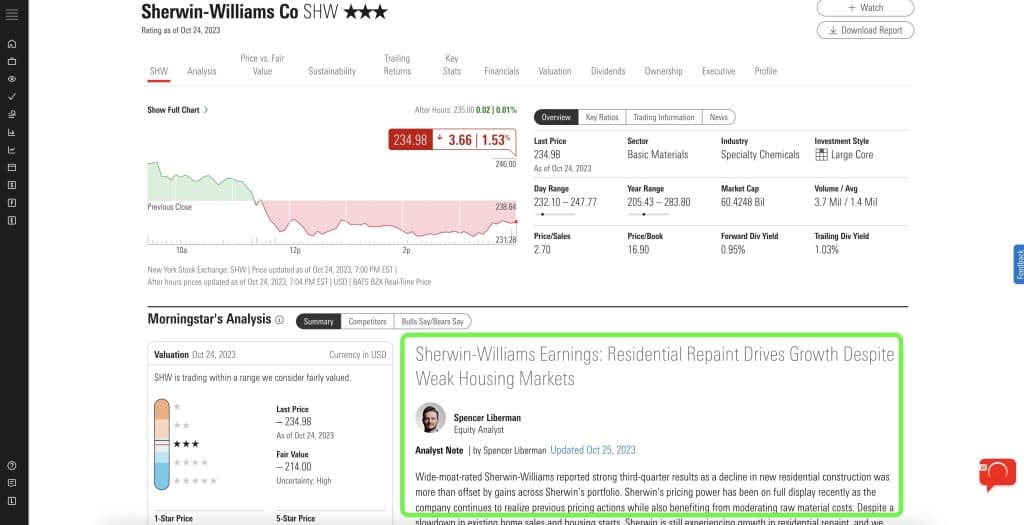
A stock's research page inside Morningstar Investor: fair-value estimate, star rating, moat and uncertainty ratings above the written report.
The fair-value estimate is Morningstar's opinion of what the shares are worth, per share. It comes from a discounted cash flow model, which values a company on the cash it is expected to make in the years ahead. Beside it sits an uncertainty rating (Low, Medium, High, Very High or Extreme). That rating says how confident the analyst is that the estimate is close. There is also an economic moat rating (wide, narrow or none), for how long the company's advantage should last. Wide means Morningstar expects the advantage to last more than twenty years, narrow about ten. Each of the three is an opinion, and each is stated with its basis.
Star ratings for stocks. The star rating is the fair-value estimate turned into a signal. Five stars means the stock trades well below what Morningstar's analyst thinks it is worth. One star means well above. The uncertainty rating widens the band: a High-uncertainty stock needs a bigger discount to earn five stars than a Low-uncertainty one. The rating moves with the price every trading day. So a stock can go from three stars to five without any change in Morningstar's view of the business.
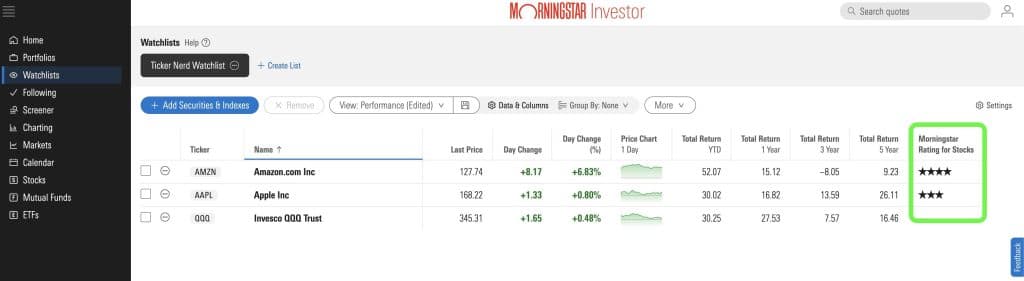
Morningstar's star scale for stocks: price against the analyst's fair-value estimate.
Read it as what it is. Five stars is Morningstar saying "cheap against our estimate". That is one house's opinion of value. It says nothing about when, or whether, the price closes the gap. Morningstar publishes the method and the estimate behind the rating, which is more than most rating systems do. That openness is a reason to read the rating, and the rating alone is still not enough to act on.
Star and Medalist ratings for funds. Fund star ratings are a different thing, and mixing the two up is the most common complaint about Morningstar. For a fund or ETF, the star rating looks backward. It ranks past returns, adjusted for risk, against the fund's category over three, five and ten years. The top 10% get five stars. A fund needs 36 months of history to be rated at all. The star rating describes what happened. Morningstar's forward-looking opinion is the separate Medalist rating (Gold, Silver, Bronze, Neutral, Negative). It weighs the people, the process and the parent firm. Investopedia cites a Vanguard study which found that fund star ratings did not predict future performance against a benchmark. Morningstar itself calls the stars an achievement test. The Medalist rating is its aptitude test.
The screener. More than 200 data points on US-listed stocks, funds and ETFs. The Morningstar-only fields (star, Medalist, moat, uncertainty, fair value) work as filters. Pre-built lists cover the obvious starting points, and screens can be saved with custom column views. Morningstar has added a natural-language filter that turns a typed request into screener criteria. The earlier version of this review was written with an account. It found the "Mo" chatbot that the filter grew from too basic to lean on. The ordinary filters are the reliable route.
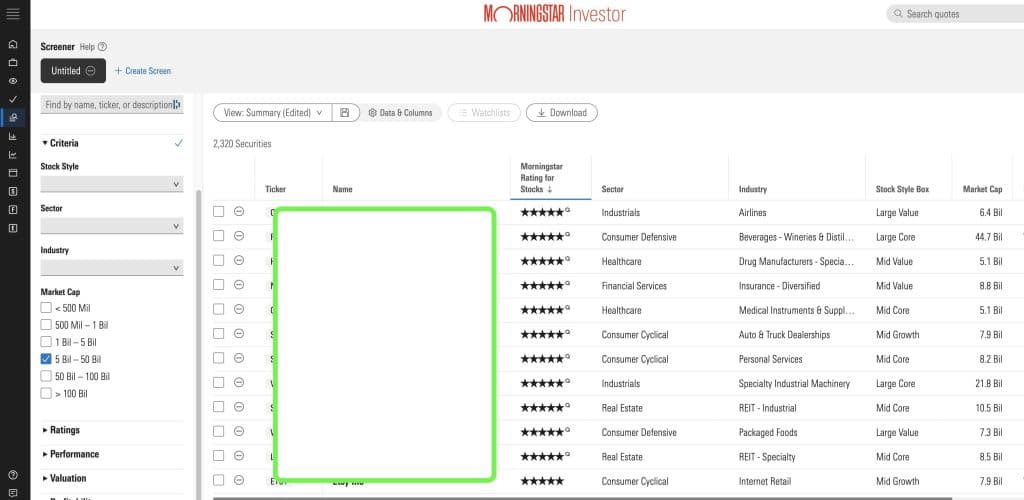
The screener, filtered on Morningstar's own ratings.
Portfolio X-Ray. Enter your holdings and X-Ray looks through every fund to the stocks inside. Then it reports on the portfolio as a whole: asset mix, sector and region weights, style box, fees, and stock overlap across funds. The style box is Morningstar's grid of company size against growth or value. The overlap view is the one feature no free tool matches well. An investor holding three large-cap funds usually finds the same ten companies in all of them. Alerts on rating changes and analyst notes for your holdings and watchlists come with it.
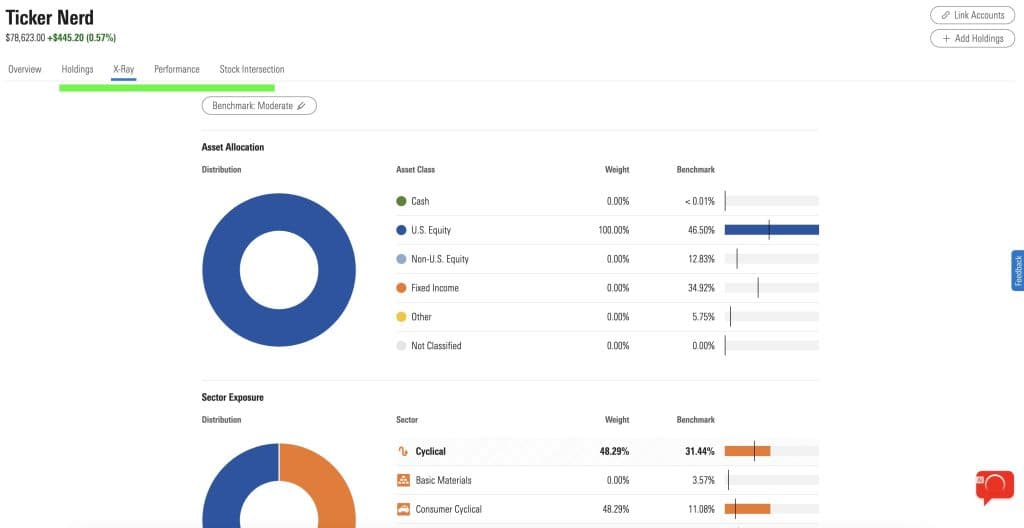
X-Ray on a sample portfolio: the holdings resolved into sectors, regions and a style box.
The newsletters are a separate product. Morningstar's paid newsletters (FundInvestor, StockInvestor, DividendInvestor and ETFInvestor) are where Morningstar does name holdings, in model portfolios run by its own editors. They are sold apart from Investor at their own prices on newsletters.morningstar.com. An Investor subscription includes none of them. If a list of named holdings is what you want, that is the Morningstar product to price. The comparison with Motley Fool below applies to the newsletters rather than to Investor.
Full access during the trial: analyst reports, fair-value estimates, the screener and X-Ray. $199 for the first year after it, renewing at $249.
Where Morningstar Investor falls short
- No refunds. Morningstar's user agreement says prepaid subscriptions are non-refundable. Cancel after the trial and you keep access to the end of the term, and that is all. The 7-day trial is the only test drive, and it ends at a fixed hour Central Time.
- Cancelling deletes your work. Portfolios, watchlists, saved screens and custom views go with the subscription. Morningstar offers a download before cancellation; take it.
- It never tells you what to buy. This is by design, and it is the most common reason subscribers leave. A five-star rating is an opinion on price against value. It does not say how much to buy, when to buy or when to sell.
- The reports assume you can read a balance sheet. Four thousand words on where a moat comes from and how the company spends its cash are the point for an experienced investor. For a beginner they are a wall.
- Coverage is deepest on large US names. Small companies, foreign listings and most companies tied to crypto get a rating generated by a computer model and no analyst report. The difference is not always obvious on the page.
- Two star systems, one word. A five-star stock is an opinion on price against value; a five-star fund is past performance. The number most people quote is the second one. Morningstar itself says it looks backward, and its pages do little to stop a new subscriber mixing the two.
Morningstar vs Seeking Alpha
Both are research platforms that leave the decision with you, and they answer the same question in opposite ways. Morningstar gives you one salaried analyst's view per stock, with a fair-value estimate and a moat rating. It covers funds and ETFs at a depth nobody else sells to individuals. Seeking Alpha Premium gives you a quant rating on nearly every US stock, refreshed daily. A quant rating is a score set by a computer model from the company's numbers rather than by an analyst. Seeking Alpha also gives you thousands of contributor articles, several per stock, arguing both sides. Its fund coverage is thin.
On price, Morningstar Investor is $249 a year at list and $199 for the first year. Seeking Alpha Premium is $299 and $269. Fund and ETF holders should take Morningstar. Stock pickers who want a screen on the numbers behind the quant rating, and a debate, should take Seeking Alpha. Investors who want an independent valuation on their picks and a quant check on the same names end up with both, at $468 for the first year.
Morningstar vs Motley Fool
Morningstar Investor rates stocks. Motley Fool Stock Advisor recommends them: two a month with a written case, at $199 a year list. If the question is "which stock should I buy", only one of the two answers it. Our comparison covers what the pairing costs and who each suits.
- Independent fair-value estimates with an uncertainty rating, from analysts paid by subscribers rather than by the companies they cover
- The deepest fund and ETF research sold to individuals, with the forward-looking Medalist rating behind the paywall
- Portfolio X-Ray looks through funds to their holdings and shows overlap no free tool matches
- A screener built on Morningstar's own ratings, with 200-plus data points and saved custom views
- $199 for the first year and a 7-day trial with full access
- No refunds: prepaid subscriptions are non-refundable and the trial is the only test
- Rates and never recommends, so there is no buy list, no guide to how much to buy and no sell signal
- Reports assume an experienced reader; beginners will find them a wall
- Fund star ratings look backward and are often mistaken for a forecast
- Cancelling deletes portfolios, watchlists and saved screens
Morningstar Investor vs Ticker Nerd
Different jobs. Morningstar tells you what its analysts think each security is worth and leaves you to build and run the portfolio. Ticker Nerd hands you a finished portfolio that rules maintain.
| Morningstar Investor | Ticker Nerd | |
|---|---|---|
| What you get | Analyst reports, fair-value estimates and ratings on thousands of stocks, funds and ETFs, plus a screener and X-Ray | The Ticker Nerd 20, a rules-run portfolio of twenty stocks |
| Who decides | You. Morningstar rates; it never recommends | Published rules over a ranked ~1,500-stock universe; the model buys and sells |
| Cadence | Ratings move daily with price; reports update on results and events | Reviewed every four weeks, with a plain-English brief per holding |
| Record | None published for the ratings as a strategy; the fair-value methodology is public | On the join page: every trade since live, losers included |
| Price | $249/yr list, $199 the first year, $34.95/mo | $199/yr |
The short version: Morningstar is the research to use if you enjoy reading the case for what a stock is worth. It suits people who will build and run the portfolio themselves. If you want the portfolio decided and maintained by rules, that is what membership is. Members who run both use Morningstar to read up on the names the model holds.
Verdict: is Morningstar Investor worth it in 2026?
Yes, at $199 for a first year, for the investor who runs their own money and holds funds in the mix. That investor holds ETFs or mutual funds beside individual stocks and has $25,000 or more at work. They want an independent view of value beside their own before they act. For them Morningstar's fair-value estimates, the fund research and X-Ray are cheap at 0.5% of a $50,000 portfolio. Nothing else sold to individuals does the fund half of the job.
Everyone else should be honest about which sentence does not fit. An index-fund holder gets a rating on two funds they were going to keep anyway. A trader gets company numbers and no charts. Someone who wants a stock named each month gets an opinion on price against value and no name. That is a different product, sold by Motley Fool or by Morningstar's own newsletters. We compare the services that do name stocks on one page, with their records and refund terms.
The trial is seven days with full access and no refund after it. Set a calendar reminder for day six before you start it.
Quick answers.
How much does Morningstar Investor cost?
Morningstar Investor is $249 a year at list, or $34.95 a month. We checked the prices on Morningstar's own pages in September 2026. Through the partner link on this page the first year is $199. The subscription then renews at the list price, $249 today, unless you cancel. Twelve months at the monthly rate come to $419. Every plan opens with a 7-day free trial, one per person for life.
Is Morningstar Investor worth it?
Yes, for an investor who runs their own money, has $25,000 or more, and holds funds or ETFs as well as stocks. That investor wants an independent analyst's estimate of what a stock is worth before buying. On a $50,000 portfolio the $249 fee is 0.5% a year. It is a poor fit if you want to be told what to buy, because Morningstar rates stocks and never recommends them. It is also a poor fit if you hold one or two index funds, or if you trade over days on charts.
What happened to Morningstar Premium?
Morningstar Premium was the previous name of the paid subscription. Morningstar launched Investor in June 2022 and converted every Premium membership to it. Premium is no longer sold. Reviews of Morningstar Premium describe the same product at an earlier stage. The analyst reports, star ratings, screener and Portfolio X-Ray all carried across. Former Premium members keep access to the legacy Portfolio Manager tool.
What is free on Morningstar and what needs a subscription?
Free: the news and editorial articles, basic quote pages, the free email newsletters, and the headline star rating on most funds and stocks. Paid: the full analyst reports, each with the analyst's estimate of what the stock is worth, plus the moat and uncertainty ratings. Paid also includes the Medalist ratings on funds, the screener with more than 200 data points, Portfolio X-Ray, custom views, and alerts on rating changes and analyst notes. The 7-day trial opens all of it.
What do Morningstar star ratings mean?
Two different things. For stocks, the star rating is Morningstar's opinion on price against value. Five stars means the stock trades well below the analyst's estimate of what it is worth, and one star means well above it. An uncertainty adjustment makes five stars harder to earn when the range of outcomes is wide. For funds and ETFs, the star rating looks backward. It ranks risk-adjusted past returns against the fund's category over three, five and ten years, and the top 10% get five stars. Morningstar's forward-looking view on a fund is the separate Medalist rating.
Can you cancel Morningstar Investor and get a refund?
You can cancel at any time from My Account, then Subscription, then Cancel. You can also cancel by phone or by emailing cancellation@morningstar.com. Access runs to the end of the period you paid for. Refunds are not given: Morningstar's user agreement states that prepaid subscriptions are non-refundable. Cancelling during the 7-day trial costs nothing. The trial ends at 11:59 PM Central Time seven days after it starts. Cancelling also deletes your portfolios, watchlists and saved screens, so download them first.
Morningstar or Seeking Alpha?
Morningstar Investor ($249 a year, $199 the first year) gives you one house view per stock: a salaried analyst's estimate of what it is worth and a written report. It also has the deepest fund and ETF research sold to individuals. Seeking Alpha Premium ($299 a year, $269 the first year) gives you a computer-scored quant rating on nearly every US stock, refreshed daily. It also gives you thousands of contributor articles arguing both sides. Fund investors and one-view buyers should pick Morningstar. Stock pickers who want debate and a screen on the numbers behind that rating should pick Seeking Alpha.
Morningstar or Motley Fool?
Different products. Morningstar Investor is a research platform. It rates stocks and funds and leaves the decision to you. Motley Fool Stock Advisor ($199 a year at list) is a picks service. It names two stocks a month and tells you why. If you want research, pick Morningstar. If you want to be told what to buy, pick Motley Fool. Many investors run both: the Fool for ideas, and Morningstar to check what an independent analyst thinks each one is worth.
The market re-ranks every week. Monday's email says what moved.
Computed off the Friday close and sent before the US open.
Market Radar reports the week’s largest rank changes across roughly 4,600 US stocks, the factor behind each one, and where the market went.